
Fair Deal Scheme Ireland Explained
A plain-English guide to the Fair Deal Scheme in Ireland
The Fair Deal Scheme, officially called the Nursing Homes Support Scheme, helps people in Ireland pay for long-term nursing home care.
If your parent, spouse, partner or family member needs long-term nursing home care, Fair Deal can help cover the cost. The person in care pays a contribution based on their income and assets, and the HSE pays the balance of the approved nursing home cost.
Fair Deal can be very helpful, but it is not always straightforward. The application involves a care needs assessment, a financial assessment, supporting documents and, in some cases, a decision about whether to apply for the Nursing Home Loan.
FairDeal360.ie helps families understand the process, prepare properly and make informed decisions before submitting an application.
What is the Fair Deal Scheme?
Fair Deal is a State support scheme for people who need long-term nursing home care.
If approved, the person going into care pays an assessed weekly contribution, and the HSE pays the balance of the nursing home fee for an approved nursing home. The scheme can apply to public, voluntary and approved private nursing homes.
Fair Deal does not usually cover short-term care such as respite, convalescence or day care. It also does not cover all extras charged by a nursing home, such as hairdressing, therapies, social activities or other additional services.

Who can apply for Fair Deal?
A person can apply for Fair Deal if they:
- are ordinarily resident in Ireland
- need long-term nursing home care
- are approved by the HSE following a care needs assessment
Fair Deal funding must be approved before State support can be paid. The HSE states that Fair Deal funding cannot be backdated and is only paid from the date it is approved, so timing can matter.
How the Fair Deal application process works
Fair Deal has two main assessments.
1. Care Needs Assessment
The HSE assesses whether long-term nursing home care is the most appropriate option. This assessment looks at the person’s health, ability to manage daily activities, available family and community support, and whether they could reasonably be supported at home.
If the person is not assessed as needing long-term nursing home care, they will not qualify for Fair Deal funding.
2. Financial Assessment
The HSE then assesses the person’s income and assets to calculate how much they should contribute towards the cost of care.
The HSE pays the balance between the person’s assessed contribution and the approved nursing home fee.
For example, if the nursing home costs €1,400 per week and the person’s assessed contribution is €500 per week, the HSE may pay the balance of €900 per week, subject to approval and funding availability.
What income and assets are assessed?
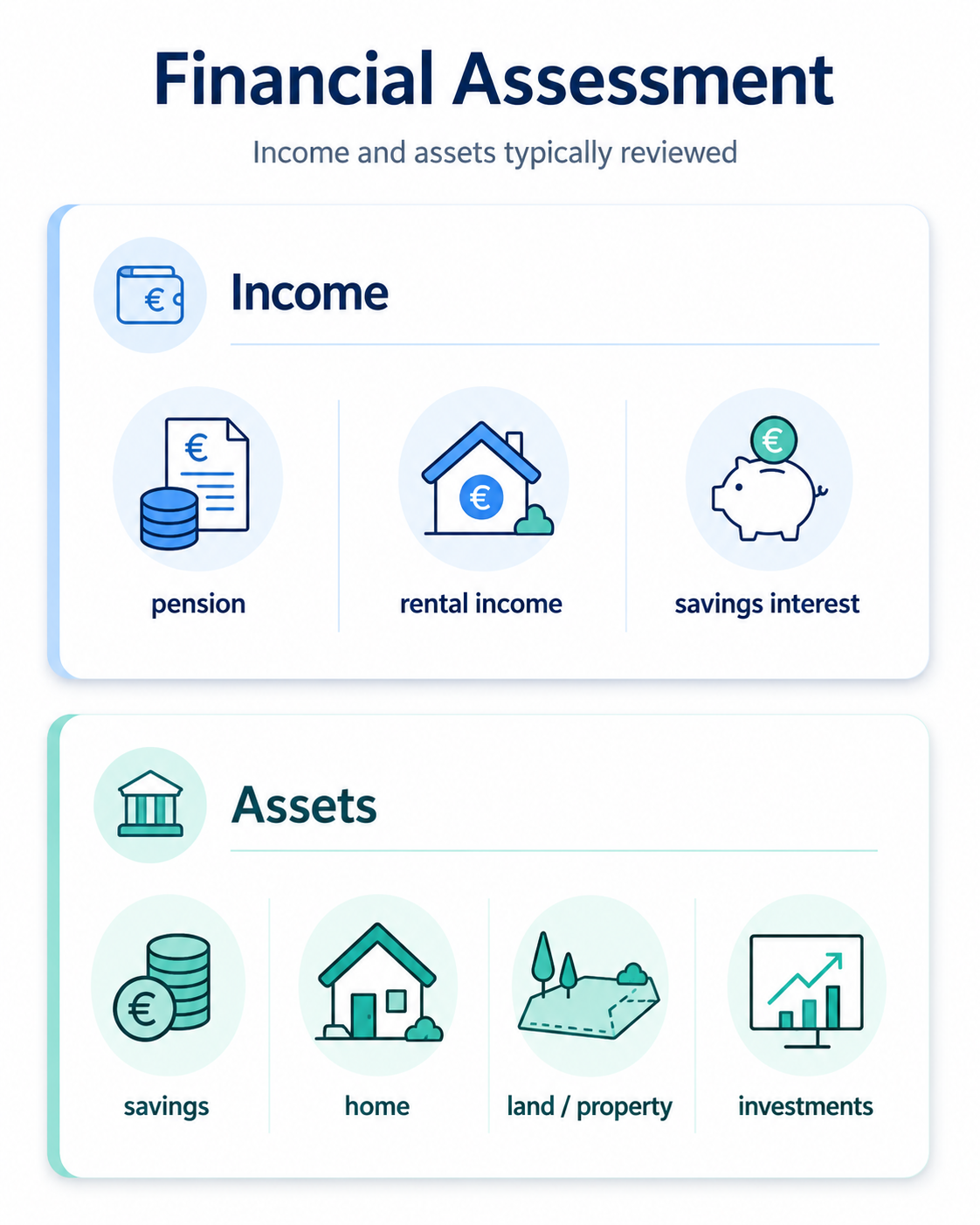
The financial assessment looks at income and assets.
Income may include:
- State pension
- occupational pension
- social welfare payments
- rental income
- employment or business income
- dividends, interest or other investment income
Assets may include:
- savings and deposits
- shares and investments
- the family home
- other property or land
- business or farm assets
- assets transferred in the previous five years
The assessment can be more complex for couples, farms, businesses, rental properties, transferred assets and families considering the Nursing Home Loan.
How much will you pay under Fair Deal?
In broad terms, a person may be assessed on:
- 80% of their income, after allowable deductions
- 7.5% per year of the value of their assets, after the relevant asset disregard
The first €36,000 of assets, or €72,000 for a couple, is not counted in the financial assessment. If the person is part of a couple, the assessment is generally based on half of the couple’s combined income and assets.
For couples, the contribution is generally calculated at half the single-person rate, meaning 40% of income and 3.75% of assets per year may apply to the person entering care.
What is the three-year cap?
The three-year cap limits how long certain assets are included in the Fair Deal financial assessment.
For example, the family home is generally assessed at 7.5% per year for a maximum of three years. This means the total contribution based on the home is normally capped at 22.5% of its value for a single person.
For a couple, the rate is generally 3.75% per year, capped at 11.25% over three years for one partner in care.
The three-year cap can also apply to certain farms and businesses, but only where specific conditions are met. However other assests such as investments and pension pot are not subject to a 3 year cap.
What is the Nursing Home Loan?
The Nursing Home Loan, also called Ancillary State Support, is an optional part of Fair Deal.
It allows a person to defer paying the portion of their Fair Deal contribution that relates to Irish land or property. Instead of paying that property-based contribution during their lifetime, the HSE pays it on their behalf as a loan.
The loan is later repaid to the State, generally after the person dies or after the property is sold or transferred. Repayment is made through Revenue.

When might the Nursing Home Loan be useful?
The Nursing Home Loan may be helpful where:
- the person owns a home, land or property in Ireland
- most of their wealth is tied up in property
- they do not have enough liquid savings to pay the property-based contribution
- the family does not want to sell the home immediately
- a spouse, partner or qualifying person is still living in the home
- the family wants time to consider longer-term property decisions
The Nursing Home Loan can reduce the immediate cash pressure on the person in care and their family.
Important things to understand about the Nursing Home Loan
The Nursing Home Loan is not free money. It is a loan secured against property or land.
A charge is placed on the relevant asset. This is a legal charge, similar in principle to a mortgage. The amount due is normally repaid after death or after sale or transfer of the asset.
Families should understand:
- who owns the property
- whether there are joint owners
- whether a spouse or partner still lives in the home
- whether there is an enduring power of attorney, decision support arrangement or other legal authority
- whether legal advice is needed
- when repayment may become due
- how the loan could affect inheritance or estate planning
The HSE notes that independent legal advice may be appropriate before applying for the Nursing Home Loan.
Advantages of Fair Deal
1. It makes long-term nursing home care more affordable
Nursing home fees can be significant. Fair Deal means the person contributes according to their assessed means, and the State pays the balance where approved.
For many families, this is the only realistic way to fund long-term nursing home care.
2. The person’s contribution is based on their means
Fair Deal looks at income and assets rather than requiring every family to pay the full private nursing home cost directly.
This can provide a more structured and predictable way to manage care costs.
3. The person can choose an approved nursing home
A person approved for Fair Deal can choose any nursing home that participates in the scheme, provided the home has a suitable place available and can meet the person’s care needs.
4. The family home may be protected from open-ended assessment
The three-year cap means the family home is not normally assessed indefinitely. This can be important where families are concerned that long-term care costs will consume the full value of the home.
5. The Nursing Home Loan can avoid an immediate sale of property
Where suitable, the Nursing Home Loan can defer the property-based contribution. This may give families breathing space and avoid a rushed property sale.
6. It provides a formal State-backed process
Fair Deal is a structured HSE scheme with a formal application process, assessment process and appeal/review mechanisms.
Potential disadvantages and downfalls of Fair Deal
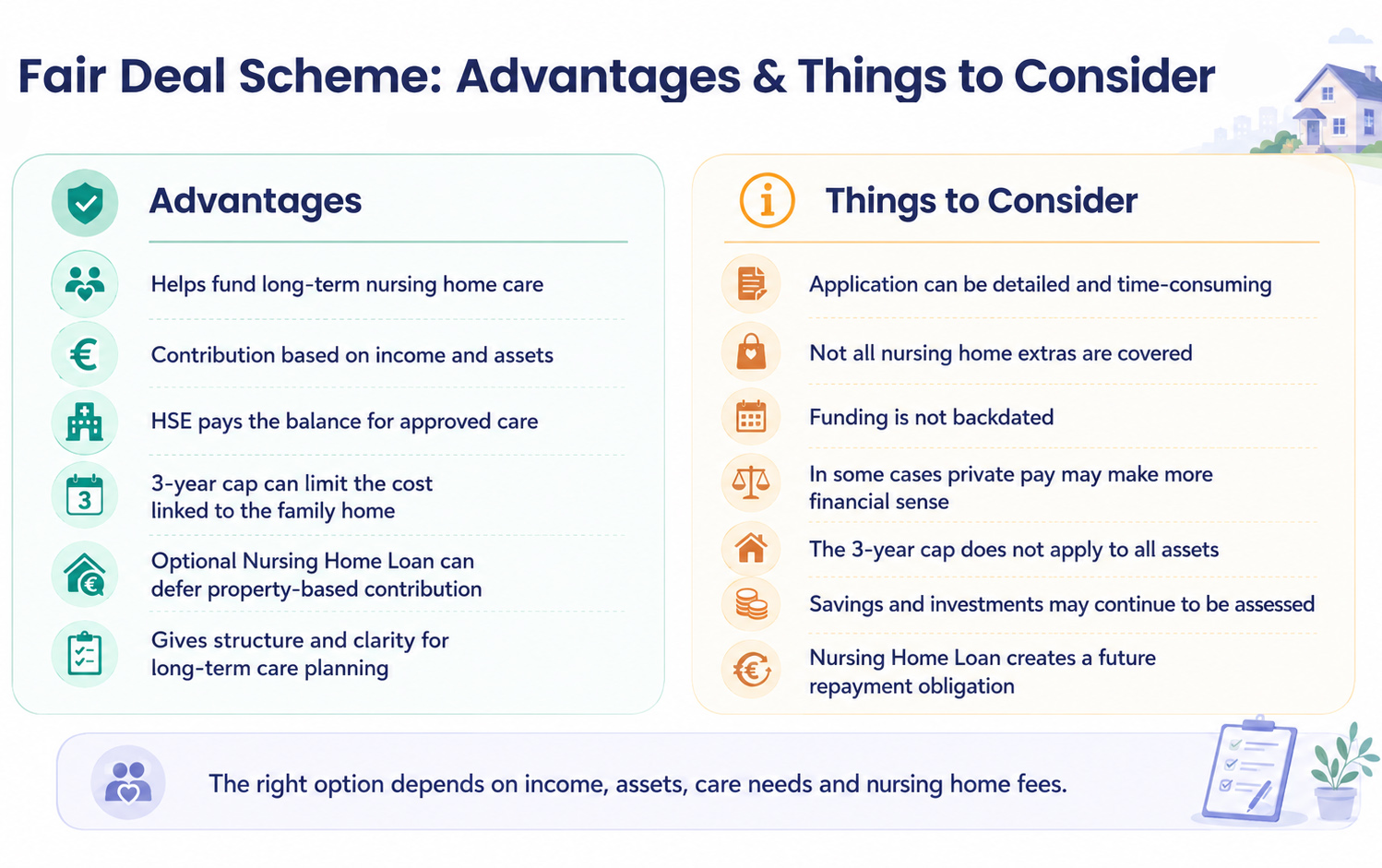
Fair Deal is valuable, but families should not assume it is always simple or always the best option. In some cases, depending on the person’s income, assets and the cost of the chosen nursing home, it may make more financial sense to pay privately, at least for a period of time.
1. The application can be detailed and time-consuming
The application involves forms, financial details, supporting documents and, in some cases, legal or property information.
Families may need to gather:
- pension details
- bank statements
- property valuations
- mortgage or loan details
- details of transfers or gifts
- rental income information
- investment or pension fund details
- evidence of authority to act on behalf of the person
Incomplete or inaccurate information can delay the process.
2. Fair Deal does not cover every cost
Fair Deal does not cover all nursing home extras. Families should check the nursing home contract carefully for additional charges.
Possible extra costs can include: therapies, activities and other optional or mandatory charges. The CCPC advises that nursing home contracts should clearly explain extra services and charges.
3. Funding is not backdated
If a person enters a nursing home before Fair Deal is approved, the family may need to fund the private cost until approval. The HSE states that Fair Deal funding cannot be backdated and is only paid from the date it is approved.
4. Paying privately may sometimes make financial sense
Fair Deal is designed to provide State support where the person’s assessed contribution is lower than the nursing home fee. However, if the person has substantial income and assets, their assessed contribution may be close to the full cost of care.
In that situation, the financial benefit of applying for Fair Deal may be limited. Some families may decide to pay privately, particularly where:
- the person’s assessed contribution is likely to be close to or more than the nursing home fee
- the person has complex assets or family arrangements
It means the numbers should be reviewed before assuming it is automatically the best route.
5. The 3-year cap does not apply to all assets
The 3-year cap is often misunderstood.
It can limit the contribution based on the person’s home to a maximum of three years. It may also apply to the proceeds of sale of the home, and in certain cases to a qualifying farm or business. The HSE states that the cap applies to homes, farms and businesses, subject to the relevant rules.
However, the cap does not generally apply to other assets such as:
- savings
- pension pot or ARF
- deposits
- shares
- investment portfolios
- other cash assets
- certain pension or retirement assets, depending on how they are held and assessed
These assets may continue to be assessed for as long as the person remains in long-term nursing home care. For example, the HSE gives an example where, after the home falls out of the assessment under the 3-year cap, the person still continues to pay a contribution based on income and cash savings.
This is important because families sometimes assume that all assets stop being assessed after three years. That is not the case.
6. The Nursing Home Loan creates a future debt
The Nursing Home Loan can be useful, but it creates a debt that must usually be repaid later. This can affect: the estate, beneficiaries, a future property sale, joint owners, family members expecting to inherit the property
The loan can help avoid the immediate sale of a home, but it should still be understood as a deferred liability.
7. It may not be suitable for short-term care needs
Fair Deal is for long-term nursing home care. It is not designed for short-term respite, rehabilitation, convalescence or day care. If the person may only need short-term support, other options may be more appropriate.
Important financial point
Fair Deal is not always automatically the cheapest or best option. The right decision depends on the person’s income, assets, property, pension arrangements, expected length of stay and the nursing home fees. A proper review can help families understand whether Fair Deal, private payment, or a combination of both is the most suitable route.
Where Fair Deal might not be appropriate
Fair Deal may not be the right route in every case.
It may be less suitable where:
- the person does not need long-term nursing home care
- the family only needs short-term respite or convalescent care
- the person can be supported safely at home with home care
- the person’s assessed contribution may be close to or higher than the nursing home fee
- the person has complex property, business or farm arrangements that need careful planning first
- the family needs urgent care and cannot wait for the application process
- there are legal authority issues, such as no enduring power of attorney or decision support arrangement
- the person owns assets outside Ireland
- the family has recently transferred assets and needs to understand how this may be treated
- there are disputes between family members about the home, care decision or application
In these situations, it is important to review the facts carefully before applying or before choosing a nursing home.
Common family questions
Will Fair Deal take the family home?
Fair Deal does not automatically “take” the family home. However, the value of the home may be included in the financial assessment for a period, and if the Nursing Home Loan is used, a charge may be placed against the property.
The impact depends on ownership, whether the person is single or part of a couple, whether someone remains living in the home, and whether the Nursing Home Loan is used.
Do we have to sell the house?
Not necessarily. The Nursing Home Loan may allow the property-based part of the contribution to be deferred, meaning the home does not have to be sold immediately. However, the deferred amount normally becomes repayable later.
Can we apply before choosing a nursing home?
Yes. It is often sensible to start the process early, especially where long-term care is likely. The chosen nursing home must be approved under the scheme and must be able to meet the person’s care needs.
What happens if circumstances change?
The HSE can review the financial assessment. Families must notify the HSE of relevant changes, such as the sale of a property, death of a spouse or partner, or other material financial changes.
Can someone apply on behalf of a parent?
Yes, but the correct authority matters. If the person has capacity, they normally complete and sign the application themselves. If they cannot apply themselves, a specified person or legally authorised person may need to act on their behalf.
This can be a sensitive area and should be checked carefully before submitting an application.
How FairDeal360.ie can help
Fair Deal can be difficult to understand when families are already under emotional pressure.
FairDeal360.ie helps families by explaining the process clearly, reviewing the financial and care situation, identifying likely issues and helping families decide the best next step.
Depending on the level of support needed, we can help with:
- understanding whether Fair Deal is likely to be suitable
- explaining the financial assessment
- preparing a document checklist
- reviewing income, savings, property and other assets
- estimating likely Fair Deal contribution
- explaining the Nursing Home Loan option
- reviewing the application before submission
- managing the full application process
Our aim is to give families clarity, reduce stress and help avoid delays.
What is Fair Deal in Ireland?
Fair Deal is the common name for the Nursing Homes Support Scheme. It helps eligible people pay for long-term nursing home care. The person pays an assessed contribution based on income and assets, and the HSE pays the balance of the approved nursing home cost.
How long does Fair Deal take?
Timelines can vary depending on the completeness of the application, the care needs assessment, the financial assessment and whether the Nursing Home Loan is involved. Families should apply as early as practical because funding is not backdated.
Does Fair Deal cover private nursing homes?
Yes, Fair Deal can cover approved private nursing homes, voluntary nursing homes and public nursing homes, provided the nursing home participates in the scheme, has a place available and can meet the person’s care needs.
Does Fair Deal cover all nursing home costs?
No. Fair Deal covers core long-term nursing home care costs, but it does not cover every extra. Additional charges may apply for services such as hairdressing, activities, therapies or personal items.
What is the Nursing Home Loan?
The Nursing Home Loan is an optional part of Fair Deal. It allows a person to defer the part of their contribution based on Irish property or land. The amount is usually repaid after death or after the sale or transfer of the asset.
Is the family home included in Fair Deal?
The family home may be included in the financial assessment, but the three-year cap can limit the period during which it is assessed. If the Nursing Home Loan is used, a charge may be placed on the property.
Can FairDeal360.ie complete the Fair Deal application for us?
Yes. FairDeal360.ie can provide guidance, document review and a full application support service, depending on the level of help the family needs.